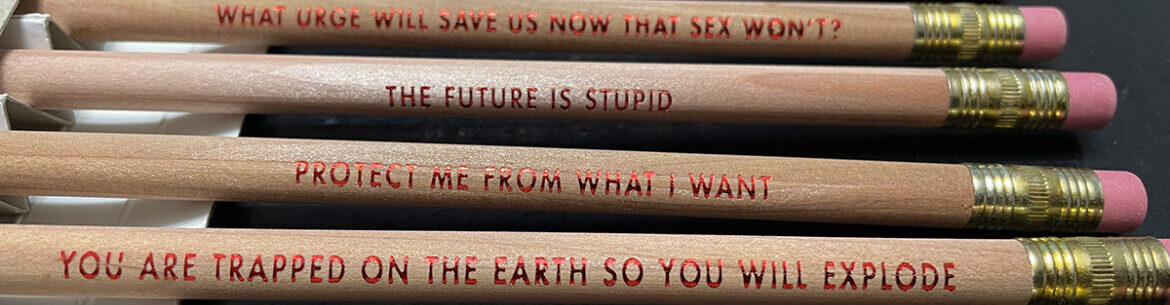

Irony & ugly feelings-feelings
 Kate Meadows (she/her/hers) on
 In “Ugly Feelings,” Sianne Ngai is working with something called “affect theory,” which to some extent involves parsing apart what is subjective and what is objective about feelings. Divided into categories, emotions and feelings are attached to the first-person subject, belong to a personal or social context, and are therefore (historically) deemed too idiosyncratic to categorize or interpret theoretically; contrarily an “affect” is removed from individualistic or social context enough for us to get away with analyzing it. In a way, it seems the sort of permission granted by distinguishing “affect” from “feelings/emotion” enabled discourse about feelings more broadly to return to fields like literary criticism. Although Ngai is clearly well-versed in the finer distinctions established by other affect theorists, she establishes her own for the sake of discussing the “ugly feelings” that form the subject of her book. She writes in her introduction:
The difference between affect and emotion is taken as a modal difference of intensity or degree, rather than a formal difference of quality or kind. My assumption is that affects are less formed and structured than emotions, but not lacking form or structure altogether; less “sociolinguistically fixed,” but by no means code-free or meaningless; less “organized in response to our interpretations of situations,” but by no means entirely devoid of organization or diagnostic powers. (2650)
Arguing that they don’t fully exist outside of language, Ngai posits that even the dilute, ambient, negative feelings (such as paranoia, envy, or irritation) merit serious discussion. She’s particularly interested in how they differ from stronger, more “cathartic” emotions (such as anger or fear) one might find driving the plot in classic literature. Within the vein of the subject-object issue presented by “affect theory,” Ngai is considering the same theoretical tension within a literary text: when considering a novel’s feel, do we owe that to the story itself or to the reader? Are there “feelings” within the text (perhaps described as experienced by the characters or inflected by narrator’s voice) that cause the reader to feel their own “feelings”?
With that strange layering of feelings on feelings in mind, I was struck by Ngai’s relating of irony—a literary term indeed—to “ugly feelings.” She argues it’s easy to feel ashamed about feeling envious, or anxious about feeling malaise (something pretty much anyone I think could relate to), and that the distance that comes with doubling feels familiar with the “ironic attitude.” She writes:
In their tendency to promote what Susan Feagin calls “meta-responses” (since it is hard to feel envy without feeling that one should not be feeling envy, reinforcing the negativity of the original emotion), there is a sense in which ugly feelings can be described as conducive to producing ironic distance in a way that the grander and more prestigious passions, or even the moral emotions associated with sentimental literature, do not. (2645)
Ngai’s writing obviously feels very relevant to the postmodern condition—at least in sense that unplaceable, inarticuable malaise and irony seem tactically entwined. It’s interesting to think about when trying to map the feel of our current era’s political satire on both the right and left, or the relationship between earnesty and the “cringe” it often produces. If you can’t cry, laugh—if your feelings have you frozen and inert, try ironic distance?

