Marx questions up
Posted by  Jeff Allred (he/him/his) on
Jeff Allred (he/him/his) on Sorry for the delay, but the study questions on Marx are posted as of Sun evening. See you Tuesday.
 Jeff Allred (he/him/his) on
 Sorry for the delay, but the study questions on Marx are posted as of Sun evening. See you Tuesday.
Jeff Allred (he/him/his) on “The better formed his product, the more deformed becomes the worker.”
1). Just from the title and the opening paragraph, I’m willing to suspect that intersectionality between philosophy and economics can be found in political realities. How this pans out for Marx and Engles I’m not sure yet, but hopefully I can get a better grounding of Marx’s work, before I start making contemporary references (which I’ll try to refrain from, or at least save until the end).
2). Political Economy – an institution with it’s own set of laws and language. Characteristics of this economy include: private property, the separation of labor, capital and land, wages, profit of capital, rent of land, division of labor, competition, exchange-value. This type of economy commodifies not only the work that people do, but workers themselves, and there value is based on their scope of production – or rather, their lack of value is inverse to their scope or production. Large economic gaps are therefore created between the haves (owners) and the have-nots (workers).
2). “Political economy proceeds from the fact of private property.” So, in keeping with the title of this essay, and my earlier thesis, when capitalistic economic systems are in play, capitalistic philosophies and values govern our society (“the interest of the capitalists to be the ultimate cause”), and this is reflected by the laws passed by the government. Competition is posited to be an external characteristic of this system, instead of something produced within the system itself.
3). Alienation of Labor:
The money system gives rise to the characteristics of the political economy. Workers lose value as they produce more.
—> This can be scene with the rise of outsourcing. For example, interesting fact: iPads would be about 3 times the price (at 1,140) if they were produced in America and it’s workers were paid for their labor. Similarly, what allows companies such as Walmart and H&M to price their goods so low is that they are only paying for the materials, not for the cost of the labor.
—>This objectification of labor can be recognized in a process called “estrangement” or “alienation.”
—>Workers are kept in conditions of abject poverty and given only enough to sustain their work, nothing more. Very true, if one examines factory and sweatshop conditions that American companies impose globally in India, China, Bangladesh, and numerous Latin American countries. This also manifests itself inside of America, especially among those who work in the service industry.
4). “So much does the appropriation of the object appear as estrangement that the more objects the worker produces the fewer can he possess and the more he falls under the dominion of his product, capital.” This idea that the more a man/woman puts into their production of goods/God, the less they have in themselves. Their work becomes external to themselves, and by extension, their “life no longer belongs to [themselves] but to the object.” The parallel of religion to capitalism is an apt one, and one I think would be fruitful to explore in a later post. At the end of this essay, Marx and Engles write “Just as in religion the spontaneous activity of the human imagination, of the human brain and the heart, operates independently of the individual – that is, operates on him as an alien, divine or diabolical activity – in the same way the worker’s activity is not his spontaneous activity. It belongs to another; it is the loss of his self.” The ultimate goals, or if not goals then consequences, of forces such as religion and money are to fragment the worker, reduce, distort, and destroy one’s humanity, and make them controllable.
Within this exists a Marxist dichotomy of Freedom/Spontaneity vs. Object bondage/Alienation
Additionally, Christianity acts as a representation of people in society – there is a camera obscura affect, and ideology is topsy turvy to the reality in a way that rationalizes injustice in the world. Religion does reflect real material conditions and indexes things the way they are, but distorts them.
5). Workers use the materials provided by nature to allow their labor to manifest itself. The resultant is that nature provides 2 type of materials: means for a worker to produce labor, and means for a worker to live (food, shelter, etc.). Therefore, the more invested a worker becomes in one usage of nature, the less important the other becomes. Just as the more a person invests in their identity as a worker, the less they are valued as a physical subject. It is only through their work that they are able to sustain their human needs.
Additionally, many of these natural are considered to be zero-sum resources: clean water, housing, food – so if one person gets it, it means another is being deprived of it. However, for the worker, it means that the more natural resources that they appropriate for labor, the less they are able to utilize for their survival, and the worker becomes a double slave of his object (the object of labour).
6). So in the next paragraph, Marx and Engles talk about the ramifications of labour for the pour, versus the ramifications of labour for the rich. The rich get things, while the poor get privation, hardship, and destitution. My question is the role that education plays in this political economy. When universities are more concerned with their brands then their students, does this reflect a commodification of education? When even something like education, which was once used as an infrastructure to raise people out of poverty, is now serving to reinforce divides between social stratospheres, how can does this illustrate communist doctrine, and explode what’s increasingly becoming a myth of meritocracy? I still don’t think I understand Marxist doctrine enough to argue it, but I think it would be fascinating to research. This is a great article about internships and this sort of “prestige economy” that unpaid internships have created, and I think it really helps makes some of the more abstract principles in this text concrete. How would Marx react to such an article? http://www.policymic.com/articles/48829/why-you-should-never-have-taken-that-prestigious-internship
It ties into the expendability of workers, and the idea of surplus labor – I think Marx would argue that free labor is an ineluctable (am I using that right?) consequence within a political economy. Prestige economies are a microcosm which reflect this. It might even be tenable that prestige economies are metonymic of the other systems produced by the money system.
7). Forced Labour – “[Work] is not the satisfaction of a need; it is merely a means to satisfy needs external to it.”
8). This quote, which is the last sentence of the essay, relates to point number 4: “As a result, therefore, man (the worker) no longer feels himself to be freely active in any but his animal functions – eating, drinking, procreating, or at most in his dwelling and in dressing-up, etc.; and in his human functions he no longer feels himself to be anything but an animal. What is animal becomes human and why is human becomes animal.”
Jeff Allred (he/him/his) on I’m slowly making my way through all of your posts thus far and giving some feedback via email. I’m about halfway through, so over the next few days, I should be getting to you if I haven’t. As was the case last time, I’ve given a provisional grade to let you know where you stand. If you think my tally of your posts is in error or you otherwise don’t understand my feedback, please get in touch.
Jeff Allred (he/him/his) on In Jakobson’s paper “Linguistics and Poetics”, he first elaborates on two terms that are central to his argument as they are broad classification systems that are thought to be in opposition. He states that “poetics deals with the problems of verbal structure” and linguistics is defined as the “science of verbal structure” (1145). Although some would separate poetics from the linguistic field, he argues that linguistics and poetics are intimately related. He remarks that “many poetic features belong not only to the science of language but to the whole theory of signs, that is, to general semiotics” (1145). For that statement to be valid, poetics and linguistics must be interconnected because the foundation of the study of language has been built on the theory of signs and semiotics. He also discards another objection in regards to the nature of poetry being “noncasual” as opposed to other verbal communication’s “casual” nature (1145). To debunk this belief he states, “any verbal behavior is goal-directed, but the aims are different…” (1146). As aforementioned, language itself is highly structured and this is validated by the fact that the study of language has spawned a wide variety of theories and fields such as semiotics.
Jakobson’s argument rests on theories grounded in and in contradiction to works by his predecessors and contemporaries. Jakobson concludes that “every language encompasses several concurrent patterns, each characterized by different functions” but that specific “speech events” are comprised of primary factors as well as “secondary factors” (1147). He expounds the six factors of a speech event which consist of an addresser (the person giving the message), context (the person, place or thing being referred to), message (the sound or utterance being made), contact (the medium used to convey the message to the addressee), code (the language or rules used in the code) and the addressee (the “decoder of the message”) (1147). After delineating the structure of a verbal message he outlines the function of various verbal messages. These functions include the emotive (focused on the addresser), the conative (focused on the addressee), the referential (focused on the context), the phatic (focused on the context) and the metalingual (focused on the code) and poetic functions (focused on the “message for its own sake”) (1148-1151).
Jakobson finds the use of the poetic function within and outside of poetry. Just as the interjection or the imperative are the purer forms of the emotive and conative functions respectively, “verbal art” is one of the purest embodiments of the poetic function (1150). However, verbal art isn’t the exclusive use of this function. This is one of the reasons that Jakobson argues against restricting the poetic function to the analysis of poetry. He states that even within poetry “the particularities of diverse poetic genres imply a differently ranked participation of the other verbal functions along with the dominant verbal function” (1151). A message’s structure is governed by a primary function and its subordinate functions (1148). Jakobson gives examples of the use of the poetic function in our daily lives through the use of poetic devices such as paronomasia and alliteration.
Jakobson opens “Linguistics and Poetics” with the question, “what makes a verbal message a work of art” (1144)? Hitherto, I was taught that what constitutes as “art” is completely subjective. Whether it be a painting by a well renowned artist like Van Gogh or an exhibit including everyday objects, self-expression seems to be whatever you deign to call it. Art comes in such a broad spectrum of forms that this very characteristic of diversity is why one might be inclined to assume that it has no real structure. However, this is a deceptive notion because when this generalization is applied to different forms of art such as poetry it falls short. Jakobson’s analysis of verbal utterances and poetics is so illuminating because poetry, arguably the most structured form of language (in the eyes of many), can be found in practically all walks of human life – from works designated to the field of poetry to marketing slogans and everyday speech. The poetic function is utilized constantly. In fact, it was probably used in writing this blog post.
Jeff Allred (he/him/his) on 
Jeff Allred (he/him/his) on As a French major reading the passage about “la tour Eiffel”
took on a completely different meaning, and perhaps this isn’t
the angle from which it should be approached but such a thing
did change my experience and give credence to the claims put
forward in this piece. Even now as I sit here in my room
typing this compulsory blog post, there is on my left an
Eiffel tower constructed in metal sitting atop my desk. What’s
funny is that I never sought to own this object, but its
status as the ultimate signifier of all that is French brought
it into my life. The tower was a gift given to me after I
completed high school as a present deemed more than
appropriate for a French major.
I think this in and of itself is representative of the
arguments that are made in the essay. Why would anyone assume
that as a lover of French culture, I would as a result like
the Eiffel tower? In reality i have a rather indifferent
feeling towards structure; in fact I would have greatly
preferred a desk guillotine. Yes although a desk guillotine
would be of great value to me, it all goes to show that
iconography leads to powerful signifiers. The Eiffel tower is
more French than France itself, than her people and even than
her flag or national anthem. Should I ever need someone to
identify France I would much sooner present them with an image
of the Eiffel tower than I would sing “La Marseillaise.”
The most interesting thing about the iconography, the great
signifier that is the tower however is its ability to be so
omnipresent and so permanent without necessarily having to do
anything. It is not the job of any signifier to be useful or
anything more than representative. It is my opinion that the
Eiffel tower comes under fire way too often for being
“inutile,” when in reality so many other important icons are
as well. The empire state building for example has a relative
uselessness for those who do not frequent the floors between
the ground and the roof on a day to day basis. Somehow despite
losing its status as the tallest building in the world however
the building continues to embody the city.
The Eiffel tower is quite special as its omnipresence is what
has allowed it to become the monster that it is today. It is
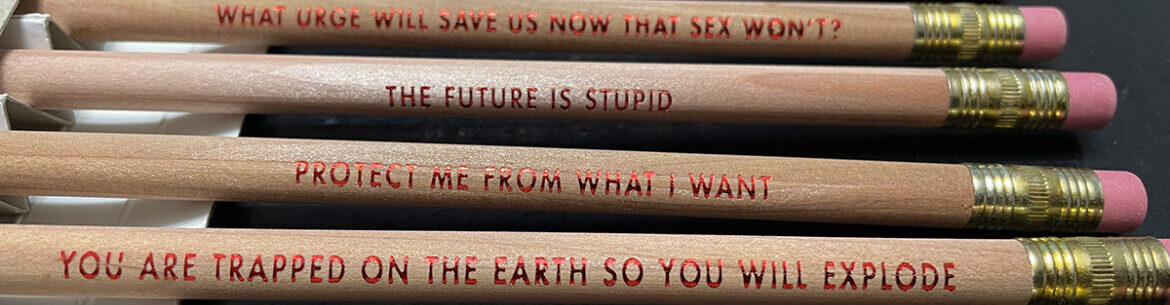
on everything considered even remotely French. I own erases,
pencils, notebooks, t shirts and all manner of things that are
considered “French” all because they possess an image of this
building. It is an interesting thing to note because it has
transcended language, history and understand. Those who do not
even know its name or the circumstances of its creation can
undoubtedly give information about its location and the people
they associate it with.
To complain about the monument perhaps only gives credence to
those who originally prayed that the tower would not be built,
but to respect it for what it is doesn’t particularly help the
deconstruction of its mythology.
Jeff Allred (he/him/his) on In Paul de Man’s “Semiology and Rhetoric,” he discusses the development of different literary theories over time including formalism, structuralism and post-structuralism, and then denounces them all. Instead, de Man proposes his idea of deconstruction. It was important for him to discuss all previous theories in his essay because deconstruction is not exactly a new theory—it is a way of pulling these existing structures apart. He believes that all previous theories have one thing in common—these binaries of form/grammar and content/rhetoric that he disagrees with. De Man criticizes formalists such as Saussure for focusing solely on form (grammar) and ignoring content (rhetoric). He feels that this method of reading severely reduces the meaning of a given text. De Man’s argument here is that there needs to be more emphasis on rhetoric but that neither rhetoric nor grammar can stand alone in providing literary meaning. Instead, both grammar and rhetoric must exist together, although you can only read a text focusing on one or the other, its important for the reader to see that the text can have multiple meanings.
De Man discusses the argument regarding the binary of form and content and how they’ve switched roles over time. “The polarities of inside and outside have been reversed, but they are still the same polarities that are at play: internal meaning has become outside reference, and the outer form has become the intrinsic structure.” However, according to deconstruction it does not matter what is inside or outside. What matters is that both of these things are connected and interdependent. Grammar on its own, for instance, cannot grasp things such as sarcasm and rhetoric alone cannot exist on its own because it needs structure to be understood. However, de Man points out that the two ways of analyzing a text cannot exist together or else they would undo each other. This made me think of the metaphor Saussure used for the signifier/signified—comparing it to a sheet of paper where you can only see one side at a time and the two sides cannot be separated.
De Man uses the example of the conversation Archie Bunker has with his wife Edith when she asks him about how he would like his bowling shoelaces tied. Archie replies with a rhetorical question—“What’s the difference?” Edith represents a formalist in this situation in the way that she takes his question literally, i.e. focusing on grammar, and begins to respond when clearly he was not asking what the actual difference was. Using the lens of rhetoric is the best way in this case to see what Archie actually meant—“I don’t give a damn what the difference is.” However, de Man’s point is that the question can be read both ways and its important as a reader to understand that and be able to read it both ways in order to extract as much meaning from the text as possible.
Jeff Allred (he/him/his) on Paul De Man makes a very important and compelling argument on semiology and rhetoric. Using Saussure’s discussion on semiology, De Man uses it as his vehicle to show how complex rhetoric is within language. In the beginning he speaks about the opposition between the form and content and that this ongoing debate is completely useless. “It matters little whether we call the inside of the box the content or the form, the outside the meaning or the appearance”, he tells us to forget about this debate between form and content and draws our attention to grammar and rhetoric. He says that there is a deep connection between the two. Grammar is the structure, or little pieces that make up the word and structurally allow it to work while rhetoric uses the structure of words to create a bigger picture. Rhetoric is the meaning behind the words which is completely dependent on the context it is being used in. There is a big relationship between the two, rhetoric is completely contingent on grammar. An idea to be questioned here is whether grammar is completely contingent on rhetoric. If something is grammatically correct, does it necessarily HAVE to have a bigger picture behind it? Can you not simply have a grammatically correct structure with a literal meaning?
A problem De Man brings to our attention is the fact a sentence can have two meanings: a literal meaning and a figurative meaning. The way we discover which meaning it can have is by looking at the “extra-textual intention”, by looking at the way the sentence is presented and the context around it, we are able to grasp what the author will truly mean. He uses Yeats’ poem as an example of how an author uses a literal example to mean something figurative but can still go either way.
I’d like to lastly bring up the point of opposition between metaphor and metonymy which I find, to be the hardest point to fathom. Metaphor is indirectly comparing something to another, or substitution versus metonymy that uses a part of something to represent the whole. De Man brings to our attention the power of the metaphor in the example over the power of metonymy “…the ‘necessary link’ that unites the buzzing of the flies to the summer makes it a much more effective symbol than the tune head ‘perchance’ during the summer” instead of using a tune that is usually played during the summer, substituting the the buzzing of the flies to represent and describe summer provides much more of an effect on the reader. Metaphor’s give us “syntactical paradigms” while metonymy gives us “syntagmatic structure”.
Jeff Allred (he/him/his) on To create a solid definition of what is considered art is one of the more strongly debated topics amongst academics who enjoy it. Poetics being the verbal/written counterpart to the visual art is just as difficult to define. One of the many problems that arise from attempting to declare what is poetic is the connection that poetry has to other forms of art that do not incorporate the verbal aspect of poetics. An example used by Jakobson is the Baroque period in art when he states that, “The problems of the baroque or any other historical style transgress the frame of a single art”, in other words art belongs to the entirety of signs or to “general semiotics”.
The link between poetics and linguistics is that poetics is part of the existing structure of language, not some interdependent distant form of communication. Poetics entails all the different functions used in linguistics to designate meaning to signs we use all around us. The resulting signified properties of poetics are as much a part of semiotics as they are a part of art, because both of these components of poetics, the structural semiotics, and the substantial content (art) of it play an equal role in determining what is poetry.
Referring to the Jakobson’s explanation of the “emotive elements” of speech, we can conclude that the emotive elements of speech link the structures of poetics to the semiotics of the real world. This connection through semiotics to the real world solidify even more sternly the relationship between poetics and the real world.
While semiotics can definitely allow us an insight into how we translate what we see around us into verbal message and thoughts is fascinating in its own right, yet that kind of analytical objective analysis of the world has its shortcomings. The use of poetics within the study of semiotics “promote *s the palpability of signs, deepens the fundamental dichotomy of signs and objects”.
After reading page 1150 of Jakobsons on Linguistics and Poetics I became aware of why there was some difficulty for me when we first began reading Semiotics in class a week ago, and that is the objective and deeply analytical style of the semiotic reading. It was not the complexity but rather the absence of poetics in the early readings. The palpability that is promoted through the use of poetics creates a springboard from which to understand semiotics by allowing a more accessible point of reference for reading it. Though now through Jakobson I have begun to experience a different understanding when re reading earlier readings like Strauss, by reading it as poetry like I would read a book, rather than trying to wrap my head around everything that is being said in an analytic frenzy.
The inner workings of language seem to be so much more complex than I would have ever expected…I though we just spoke.
Jeff Allred (he/him/his) on Hey! So these are my puzzling’s about this weeks readings. Enjoy guys!
1). Maupassant’s anecdote that the only place in France that one doesn’t see the Eiffel Tower is the Eiffel Tower – sets us up to to understand how the monument acts not only as a metaphor but as a metonymy for Paris and Parisian culture. Not only do we associate the Eiffel Tower with Parisian culture, but all of Parisian culture is sort of imbued with the idea as well as the physicality of the ‘Eiffel Tower.’ (With whatever meaning that may have.)
“It’s incorporated into daily life until you can no longer grant it any specific attribute, determined merely to persist, like a rock or the river, it is as literal as a phenomenon of Nature whose meaning can be questioned to infinity but whose existence is incontestable.”
The idea of the Eiffel Tower as a force that anchors the city and it’s inhabitants makes it perhaps more potent than humanity. Barthes goes on to say: “With it we all comprise a shifting figure of which it is the steady center.”
I think this really helps ground the significance and profundity of the image. Even though it’s easy to become so inured and sutured into our daily lives that we don’t notice the world around us, there are real and important social, political, and economic consequences that the buildings/architecture/infrastructure/advertisements have on our daily lives.
(Question: Could it be posited that the Eiffel Tower is, in a way, a metonym for Barthes philosophy about the importance of representations?)
2). Barthes then goes on to state the global consequences of the Eiffel Tower. “There is no journey to France which isn’t made, somehow, in the Tower’s name. [it is] the major sign of a people and of a place: it belongs to the universal language of travel.”
3). He then takes it a step further – and talks about how there is a human consequence that the Eiffel Tower must then have. This seemed like a key quote for me, and I thought it was really beautifully worded. “Further: beyond its strictly Parisian statement, it touches the most general human image-repertoire: its simple, primary shape confers upon it the vocation of an infinite cipher: in turn and according to the appeals of our imagination, the symbol of Paris, of modernity, of communication, of science or of the nineteenth century, rocket, stem, derrick, phallus, lightning rod or insect, confronting the great itineraries of our dreams, it is the inevitable sign; just as there is no Parisian glance which is not compelled to encounter it, there is no fantasy which fails, sooner or later, to acknowledge its form and to be nourished by it; pick up a pencil and let your hand, in other words your thoughts, wander, and it is often the Tower which will appear, reduced to that simple line whose sole mythic function is to join, as the poet says, base and summit, or again, heaven and earth.”
The Eiffel Tower stands for something ineluctable and ineffable. Because it is a cipher, it’s sort of ends up being all-encompassing – so in a way it not only negates it’s cipher status, but it reaffirms it by becoming infinite. I think it’s that’s a really beautiful sentiment, as I mentioned earlier – if I did understand it correctly.
I think it’s really interesting how Maupassant identifies himself with the Eiffel Tower – and by extension how people – like the Tower, are blinded to themselves. It really explodes the metaphorical aspects of the Tower as representative of humanity.
4). The Tower as an object that isn’t just seen, but also itself sees – being simultaneously passive and active. (Making it a complete verb)
5). Voyeuristic undertones.
6). The tower as an entity that bridges this separation between seeing and being seen.
**Need to revisit the implications of this/the idea of a spectrum of perception.
7). Inutility as a quality that keeps the Tower from being hemmed into a certain meaning or purpose: because it historically was devoid of artistic (or any specific scientific) value, it was able to take on new meanings, or rather, all meanings.
8). “Architecture is always dream and function, expression of a utopia and instrument of a convenience.”
So for Barthes, the inutility, which is linked to the infinite, supersedes the utility of a structure. An architect might present his monument as a utilitarian endeavor, but men will always return it “in the form of a great baroque dream.”
(the type of graph with a downward slope – that type of relationship)
9). The Sun Tower – “Relied on masonry and not on steel.” Had a bonfire on top that illuminated the entire city of Paris through a complex system of strategically placed mirrors. Barthes uses this anecdote to prove the naiveté of utilitarianism. “Use never does anything but shelter meaning.” He goes on to talk about “ascensional dream[s] released from “its utilitarian prop” to become an object of art.
10). “The function of art [is] to reveal the profound uselessness of objects.”
11). “The Tower, almost immediately disengaged from the scientific considerations which had authorized its birth, had arisen from a great human dream in which movable and infinite meanings are mingled: it had reconquered the basic uselessness which makes it live in men’s imagination.”
12). Barthes points out that there is nothing to be seen inside the tower. It’s emptiness/cipher status is realized in both it’s physicality and it’s potential cultural groundings. Yet it receives twice as many yearly visitors as the Louvre/movie houses, visitors who are trying to participate in a dream. However, I think that Barthes is putting too much faith into people – I visited the Eiffel Tower when I was 13, because that’s the thing one does when they go to Paris. But it’s not a symbol/metonym because people like me visit it – Most people will visit it because of it’s iconic status – not to create/find some deep.
14). Nevermind- Barthes talks about how the masses are able to transform this touristic rite into an adventure of sight and of the intelligence. He is smarter than me.
The major symbolic and the final meaning of function of the Tower (according to Barthes)
1). The Tower looks at Paris, so therefore, by transitive properties, when one visits and identifies with the Tower’s point of view they are able to “perceive, comprehend, and savor a certain essence of Paris”.
2). The Tower is able to convey the city into something natural…. throughout it’s romantic vantage point, it almost like, softens the harshness of the city. In a way, it’s a bridge from mankind to the sky- the contiguous border between the two elements. “By it, starting from it, the city joins up with the great natural themes which are offered to the curiosity of meN: the ocean, the storm, the mountains, the snow, the rivers.”
3). A new nature of human space is created by the tower – making it essentially a transitional era onto itself.
4). Both human beings and the Tower consume each other – it’s a mutual execution of transformation. This moves the Tower from being a cipher into an active sphere, in which it’s able to exert agency over the city and it’s people.
5). The Tower as a literary structure materialized into physical space. Really like the idea of this. So basically, the Tower realizes the bird-eye point of view conceptualized in The Hunchback of Notre Dame, as well as Michalet’s Tableau chronologique.
The power of intellection is assumed in a panoramic birds-eye view. Metonymy. We don’t just see the world from this vantage point, we read it. This ties into the transformational powers that the Tower has – to turn the city/it’s people into a work of literature. It gives us a new sensibility of vision, permitting us “to transcend sensation and to see things in their structure.”
6). This new mode of perception/intellect is akin to putting Paris/France under Victor Hugo’s pen, allowing for a new category of concrete abstraction. When we think of the word structure, there is implicitly “a corpus of intelligent forms”
7). Structuralism – realized whether the person visiting the tower knows it or not. Separate points are recognized and irrevocably linked together (this process is called decipherment).
8). Reconstitution of the panorama – seeking out other monuments. Memory and sensation cooperate in order to produce a unique, personalized “simulacrum” of Paris.
9). Panorama’s have a complex, dialectical nature which must be visited with a sense of continuity and struggle. Comes from a familiarity with history and myth. Can never be consumed as a work of art, in part because it’s continuously changing, unlike a fixed image. In this way, it seems that art would be aspire to the panorama.
“[To] perceive Paris from above is infallibly to imagine a history; from the top of the Tower, the mind finds itself dreaming of the mutation of the landscape which it has before its eyes; through the astonishment of space, it plunges into the mystery of time, lets itself be affected by a kind of spontaneous anamnesis: it is duration itself which becomes panoramic”.
How does this compare to Genesis?
10). Barthes goes on about how the Tower is representative of the history of Paris. Academic b.s., but basically there are two (three?) histories. “Paris, in its duration, under the Tower’s gaze, composes itself like an abstract canvas in which dark oblongs (derived from a very old post) are contiguous with the white rectangles of modern architecture. ”
11). “The visitor to the Tower has the illusion of raising the lid which covers the private life of millions of human beings; the city then becomes an intimacy whose functions, i.e., whose connections he deciphers.”
12). 3 functions of human life, all accessed by the Tower (business, knowledge, habitation).
13). The Tower as a witness, drawing the visitor to the westward and southward views (where the more affluent neighborhoods reside. West is where the sun sets. The Tower follows theses movements of development- “it even invites the city toward its pole of development.”
“The gaze fixes… the whole structure-geographical, historical, and social-of Paris space. The deciphering of Paris, performed by the Tower’s gaze, is not only an act of the mind, it is also an initiation.”
14). Cities themselves as an evolution to superior values and culture. The tower initiates non-parisians into this.
15). To visit the inside of something/the outside of something
16). The Tower offers two provisions:
a). technical, for consumption performances/paradoxes. To be an engineer by proxy. “A demystification provided by simple enlargement of the level of perception”
b). “a familiar ‘little world.'” the commerce surrounding the Tower (souvenir stalls, etc.), which harkens back to basic human instinct, and conquering of nature (with some sort of Christian-root tie-in).
17). The Eiffel Tower as a comfortable object, both modern and old.
18). IMP. QUOTE: “the Tower ultimately reunites with the essential function of all major human sites: autarchy; the Tower can live on itself: one can dream there, eat there, observe there, understand there, marvel there, shop there; as on an ocean liner (another mythic object that sets children dreaming), one can feel oneself cut off from the world and yet the owner of a world. ”
Vocab: Ineluctable – Adj. Inescapable (e.g. the ineluctable facts of history)
Oneiric – Adj. Of or relating to dreams or dreaming
Anamnesis- The idea that humans possess knowledge from past incarnations and that learning consists of rediscovering that knowledge within us.

